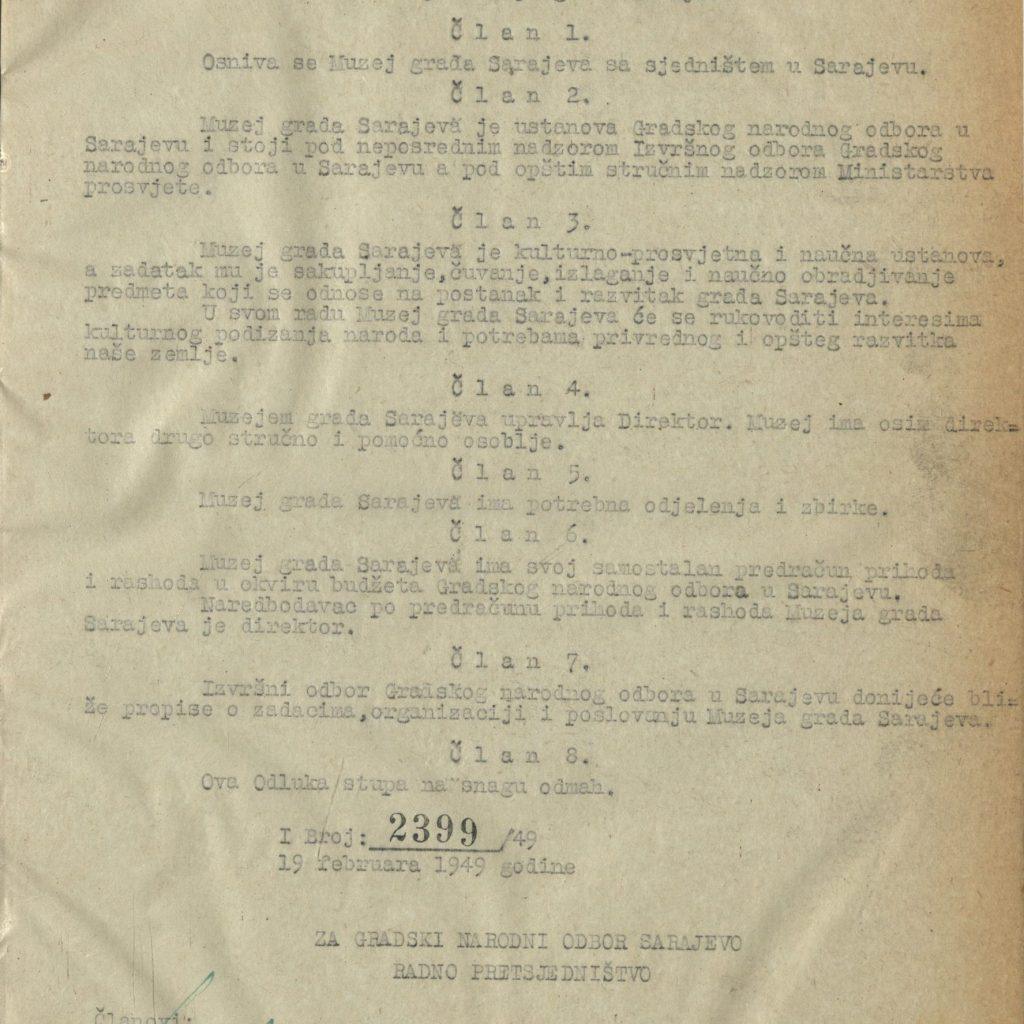
The establishment of the Sarajevo City Museum was formalized by the decision of the City People's Committee on February 19, 1949. Its mandate was to collect, organize, study, and use museological means to present the cultural, socio-political, and economic history of Sarajevo and its surrounding areas from ancient times to the present day. Initially housed in the Town Hall, the Museum's inventory consisted of only two desks, two chairs, and a bookcase. However, as the collection grew, the need for additional space became apparent. In September 1950, the Museum was allocated more space within the Town Hall, although this was a temporary solution, and there remained a need for permanent exhibition space. In 1952, the Museum, along with the City Archives, was granted use of the Judiciary and Sharia School building. The first employees included the manager Professor Vojislav Bogičević, and curator Ljubica Mladenović.
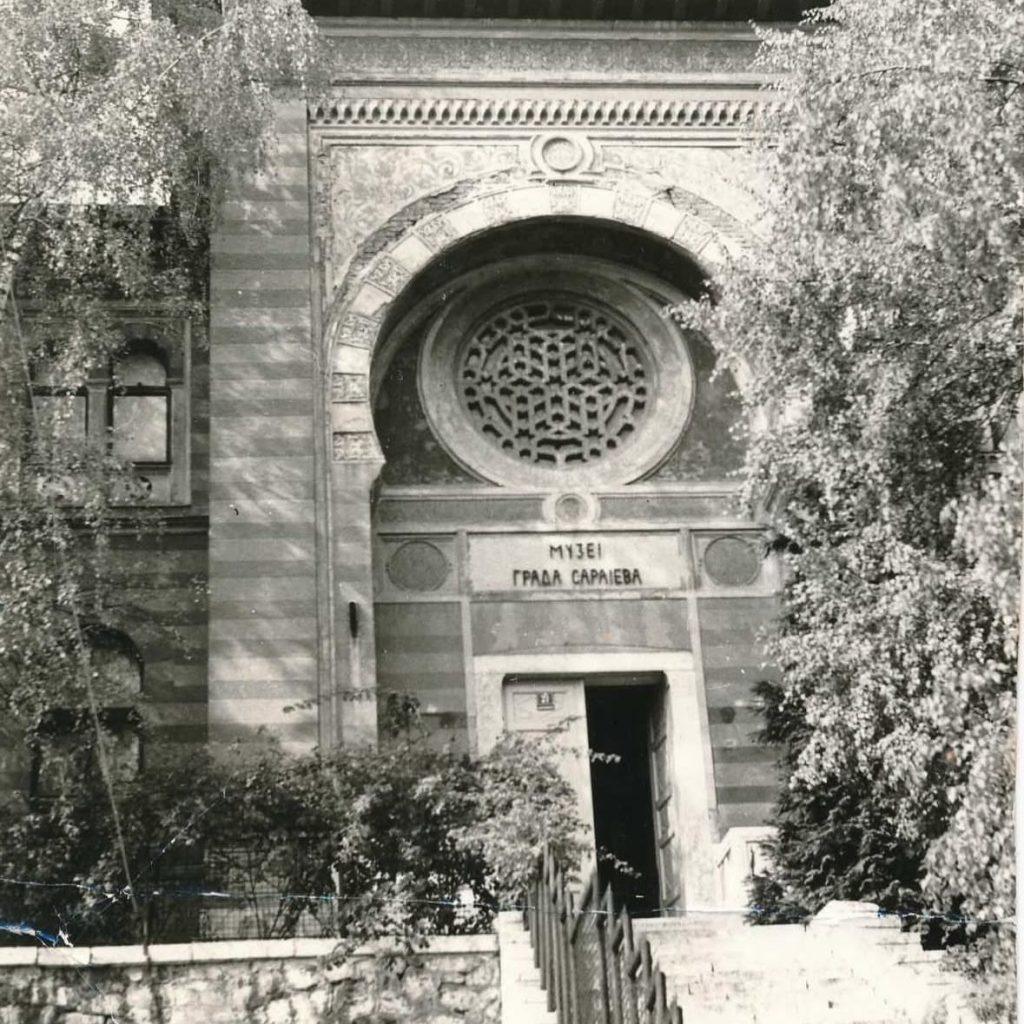
In 1951, Professor Ahmet Grebo was appointed director, a position he held for nearly two decades. The Museum's capacity expanded over time, leading to several significant developments. In 1950, an exhibition on kazaz crafts was opened in the shop of the Ćatić family on Kazazi Street in Baščaršija. In 1962/63 Svrzo's house, one of the most beautiful old Bosnian houses, was restored and opened to visitors. That same year, the decoration of the Despić family house began, and it was opened to the public the following year. On June 28, 1953, the "Young Bosnia" Museum dedicated to the Sarajevo assassination was inaugurated. The Jewish Museum officially opened in November 1966 during the 400th anniversary celebrations of the arrival of Jews in Bosnia and Herzegovina. During the 1992‒1995 war, all of the Museum's archives and exhibits were safeguarded in the Museum of the Jews of BiH, which proved the synagogue to be a secure location for preserving the Museum's artefacts.
Act of Establishment of Museum of Sarajevo
Administrative changes and the establishment of cantons brought the Museum under the jurisdiction of the Canton of Sarajevo. Consequently, by a decision of the Canton Government, its name was changed to the Public Institution Museum of Sarajevo. Today, the Museum comprises a main building with depots and administration located at Kosta Herman's Villa, and five museum buildings: Svrzo's house, Despić's house, The Jewish Museum of Bosnia and Herzegovina, the Sarajevo Museum 1878‒1918, and Brusa Bezistan with permanent exhibition showcases Sarajevo's history from prehistory through the Austro-Hungarian period. Since 1963, the Museum has been publishing the journal "Contributions to the Study of the History of Sarajevo," which is one of the oldest museological journals in the country.