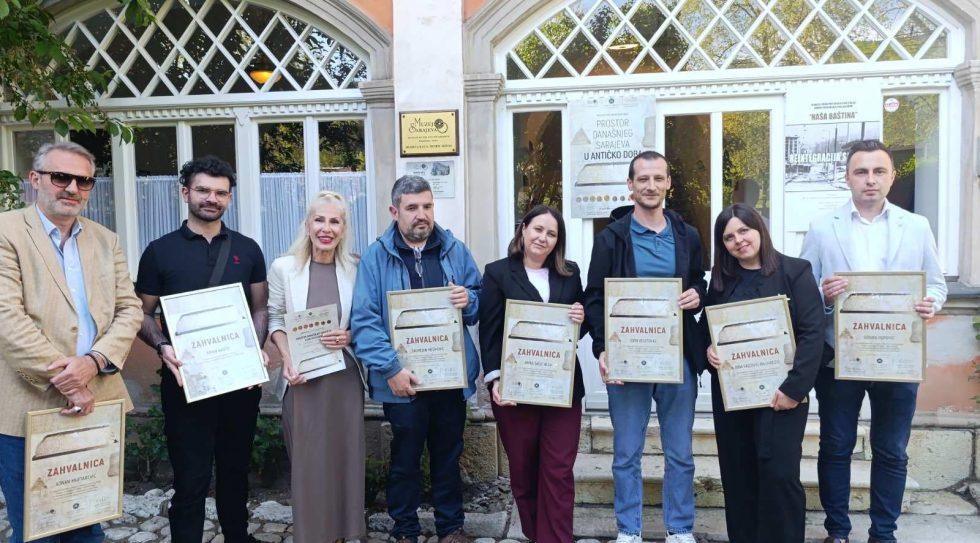
Today, a scientific meeting on the important cultural-historical and economic-tourism theme titled “The Space of Present-Day Sarajevo in Antiquity” was held at the Museum of Sarajevo, in the annex of the Despić House. The event was organized by the Faculty of Philosophy – Department of History and Department of Archaeology of the University of Sarajevo, the Center for Historical Research, and the Museum of Sarajevo. Participants included Salmedin Mesihović, Dr. Dina Vajzović-Balihodžić, museum advisor Adnan Muftarević, Dr. Jesenko Hadžihasanović, Prof. Dr. Amra Šačić Beća, Dr. Edin Veletovac, and Goran Popović.
The attendees were welcomed by the Dean of the Faculty of Philosophy, Prof. Dr. Adnan Busuladžić, and the Director of the Museum of Sarajevo, M.Sc. Indira Kučuk Sorguč, who emphasized that today’s meeting is not only a scientific event, but also a confirmation of the continuity of the Museum’s mission as a researcher and promoter of cultural and historical heritage.
“It is our obligation, together with the academic community, to continue researching, interpreting, and presenting the rich and distant past of Sarajevo and Bosnia and Herzegovina,” she stated, noting that the Museum of Sarajevo sees the Faculty of Philosophy as its key partner in the implementation of socially valuable and historically relevant research. Dean Busuladžić highlighted the increasingly fruitful and consistent cooperation between the Museum of Sarajevo and archaeologists and historians from the Faculty of Philosophy, as well as the growing openness toward the scientific and professional public. He emphasized that the topics presented systematize important research questions and offer significant scholarly contributions, which were further explored through discussion, reaffirming the importance of studying the ancient local context.
The scientific gathering was divided into two sessions: “Archaeology of the Sarajevo Region in Roman Times” and “Roman Sarajevo: Religion and Cultural Heritage.” In the first session, Salmedin Mesihović focused on an ancient residential complex in Krivoglavci, which, based on epigraphic evidence, is associated with the family of Publius Aelius Victorinus. The findings include building materials, remains of a hypocaust system, and a bronze sculpture of the god Mars, as well as an occupation layer. While the analysis suggests the possibility of identifying the structure as a villa rustica, this has not been definitively confirmed. Dina Vajzović-Balihodžić presented a classification and systematization of movable archaeological material from the sites of Ilidža, Stup, and Zenik, with particular emphasis on luxury painted ceramics and elements of Roman military equipment. In the same session, Adnan Muftarević analyzed a patera from Ilidža, discovered in 1950 and housed in the Museum of Sarajevo, within the context of the cult of Cybele and religious practices in a Roman provincial setting. Numismatic aspects were addressed by Jesenko Hadžihasanović, who examined the chronology and origin of Roman coin finds from the site of Aquae.
The second session, titled “Roman Sarajevo: Religion and Cultural Heritage,” focused on spiritual life and heritage protection. Amra Šačić Beća analyzed votive and public inscriptions from the area of the municipium Aquae, with particular attention to the cults of Apollo Tadenus, Silvanus, Silva, and the Capitoline Triad. Edin Veletovac discussed the process of Christianization and the development of church organization from the 1st to the 6th century, based on available archaeological and written sources. The session concluded with a presentation by Goran Popović, who analyzed the current state of protection of archaeological sites in the Sarajevo region and proposed measures for their documentation and digital and AI-based presentation.
As one of the notable features of ancient Sarajevo, it was highlighted that a central heating system (hypocaust) was in use during the Roman period, as evidenced by findings in the Ilidža area. Together with thermal baths and spa complexes, this indicates the high level of development of the municipium Aquae.
Following the presentations, a productive discussion took place, with contributions from historians and museologists who raised important questions regarding the future of ancient heritage and offered critical perspectives on its current state and preservation. It was concluded that Roman heritage in Ilidža, as well as in other locations in the wider Sarajevo region, requires significantly better protection and promotion. Representatives of cultural, historical, and educational institutions announced a joint initiative to the relevant authorities aimed at protecting and properly marking existing archaeological remains, ensuring their professional evaluation, and presenting them to the public through an open archaeological park or similar formats. Without such efforts, these sites risk remaining invisible in their original locations.
The outcome of this meeting is expected to strengthen cooperation between the academic community and cultural institutions, creating a solid foundation for the further scientific evaluation and promotion of ancient Sarajevo as an integral part of European civilizational heritage.