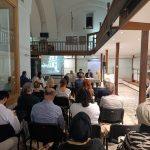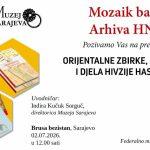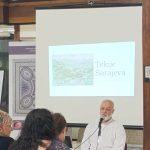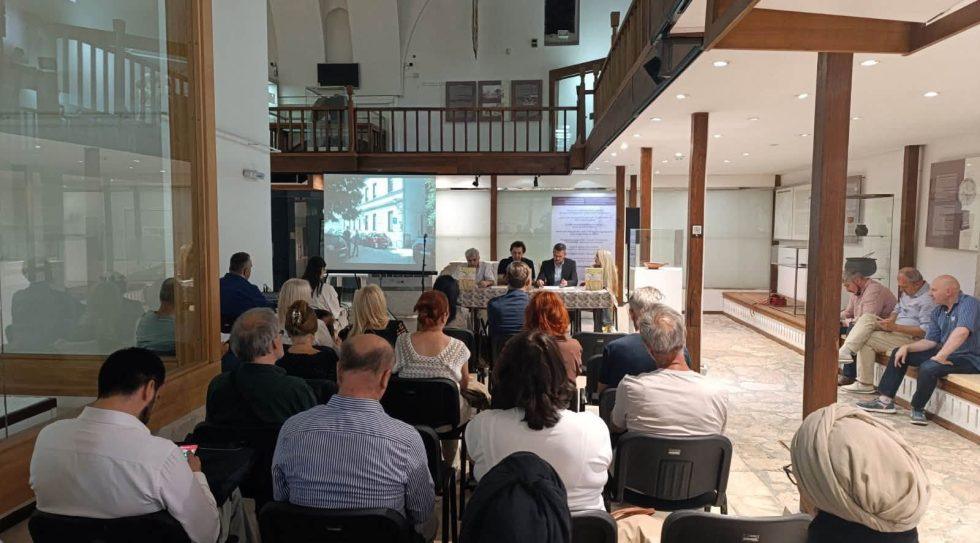
A cultural event entitled "Mosaic of the Heritage of the Archives of the Herzegovina-Neretva Canton" was held in the unique setting of Brusa Bezistan, a branch of the Public Institution Museum of Sarajevo. On this occasion, the Archives of the Herzegovina-Neretva Canton presented part of its rich cultural and historical heritage to the public. The event focused on the Archives' monograph, its Oriental Collection, and the invaluable legacy of Hivzija Hasandedić, one of Herzegovina's most distinguished researchers.
The event was opened by the Director of the Public Institution Museum of Sarajevo, Indira Kučuk-Sorguč, who emphasized that the cooperation between the two institutions serves as an example of responsible partnership in preserving and promoting the cultural heritage of Bosnia and Herzegovina.
"Our shared mission is to make archival materials, manuscripts, and historical documents accessible to both the academic community and the wider public, reaffirming that primary sources are the foundation of all serious historical research. Of particular importance is the promotion of the work of Hivzija Hasandedić, whose research into Oriental manuscripts, waqf deeds (vakufnames), and epigraphic monuments has left an indelible mark on Bosnian historiography and Oriental studies," Kučuk-Sorguč stated.
The event also reflected a new and more dynamic direction in the work of the Archives of the Herzegovina-Neretva Canton. The institution's Director, Amir Kadribegović, noted that until 2025 the Archives had never organized a public event in Sarajevo, whereas this was already its third event in the capital within the past fourteen months.
"Over the past three years, the Archives has made significant organizational and infrastructural progress. We have invested considerable effort in developing new programmes, which provide the best possible platform for presenting our exceptionally rich archival holdings. By the end of this year, we plan to organize two more exhibitions and two scientific conferences, representing another important professional milestone. Together, the monograph, the Oriental Collection, and the scholarly legacy of Hivzija Hasandedić form an inseparable mosaic of heritage that we are proud to present today," Kadribegović said.
The scientific and historical significance of the presented material was discussed by Aladin Husić, Director of the Oriental Institute, who described Hasandedić as the true founder of the Oriental Collection of the Archives of the Herzegovina-Neretva Canton. Thanks to his decades of dedicated fieldwork and research, Herzegovina today possesses an invaluable cultural treasure.
"Thanks to Hasandedić's efforts in collecting manuscripts, sijils, and numerous other valuable documents, Herzegovina today holds one of the richest collections of Oriental sources in Bosnia and Herzegovina, second only to Sarajevo. What makes this collection particularly valuable is that it encompasses not only Mostar but also materials from numerous towns across Herzegovina, making it an indispensable resource for studying the history of the entire region," Husić emphasized.
Jasmin Branković, representing the Federal Ministry of Education and Science, spoke about the institution's seven decades of development. He recalled that the growth of archival services was closely linked to the post-war reconstruction of state institutions and highlighted that the Archives of the Herzegovina-Neretva Canton has grown into a respected institution thanks to generations of archivists, among whom Hivzija Hasandedić and Ravijojla Rava Kolak hold a particularly important place. According to Branković, the Archives successfully combines respect for tradition with modern archival practices, making its holdings increasingly accessible to researchers and the wider public.
The successful presentation at Brusa Bezistan once again demonstrated that archival materials are far more than silent witnesses of the past. They represent a living and dynamic part of contemporary cultural life, playing a vital role in preserving the collective memory and cultural heritage of Bosnia and Herzegovina.